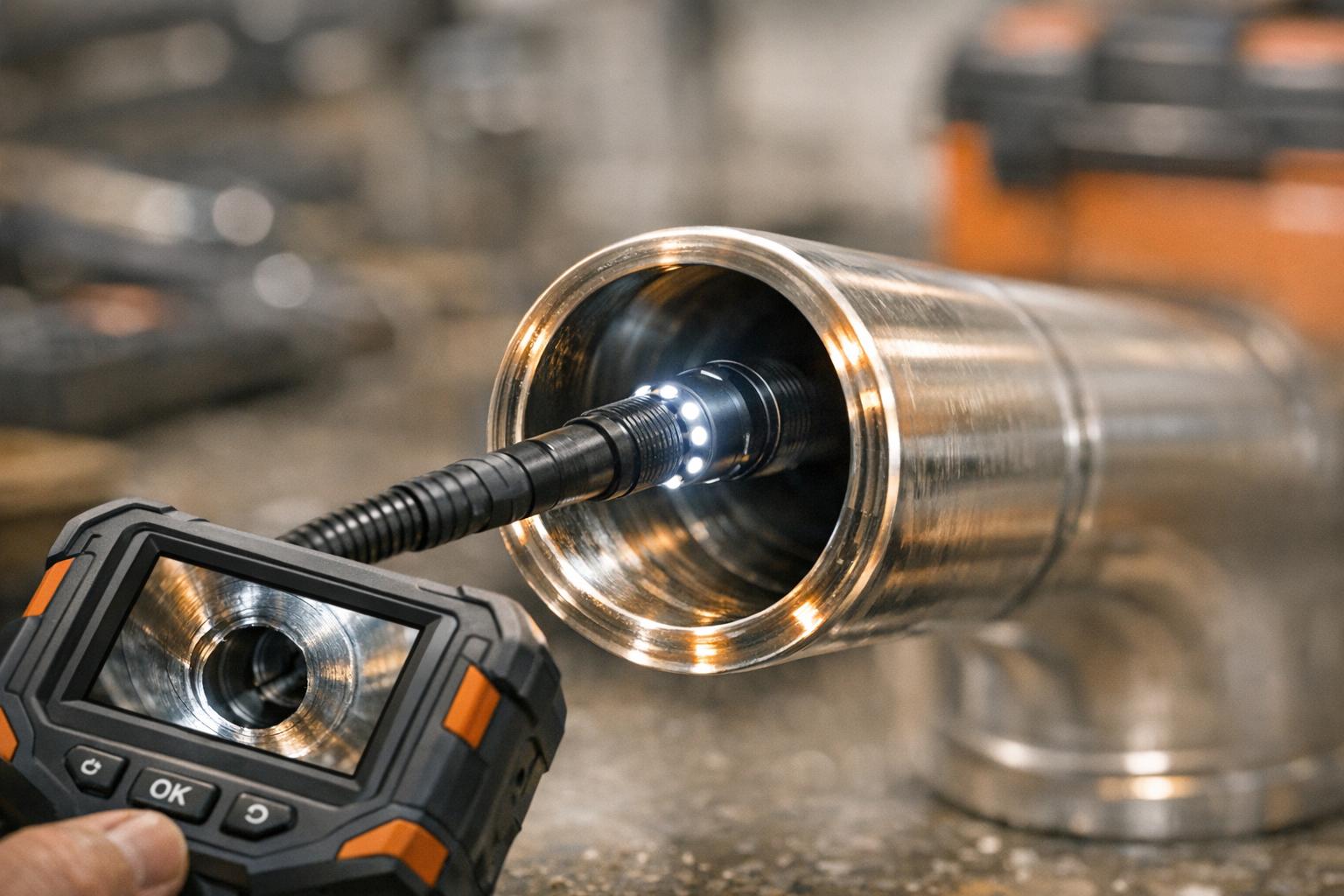

In Toronto, where older homes often feature fragile clay pipes and harsh winters exacerbate plumbing issues, modern tools have transformed drain inspections. These tools are faster, more precise, and avoid unnecessary digging, saving homeowners significant costs. Here are the top five tools used for efficient drain inspections:
- Video Drain Inspection Cameras: Detect cracks, blockages, and root intrusions with high-definition visuals. Ideal for residential, commercial, and municipal properties.
- Locating and Mapping Devices: Pinpoint the exact location and depth of pipe issues, reducing unnecessary excavation.
- Robotic Mainline Cameras: Inspect larger municipal and commercial sewer lines with advanced imaging for detailed diagnostics.
- Acoustic Sewer Line Assessment Tools: Use sound waves to quickly identify blockages in large-scale sewer networks.
- High-Pressure Drain Jetting Equipment: Clear stubborn clogs like grease, tree roots, and debris with powerful water streams.
Key Takeaway
These tools not only prevent costly repairs and property damage but also help Toronto homeowners qualify for subsidies like the Basement Flooding Protection Program. Regular inspections, especially for older homes, can save thousands in repair costs and protect your property from sewage backups and flooding. If you encounter a sudden blockage, contact a Toronto emergency plumbing service immediately.
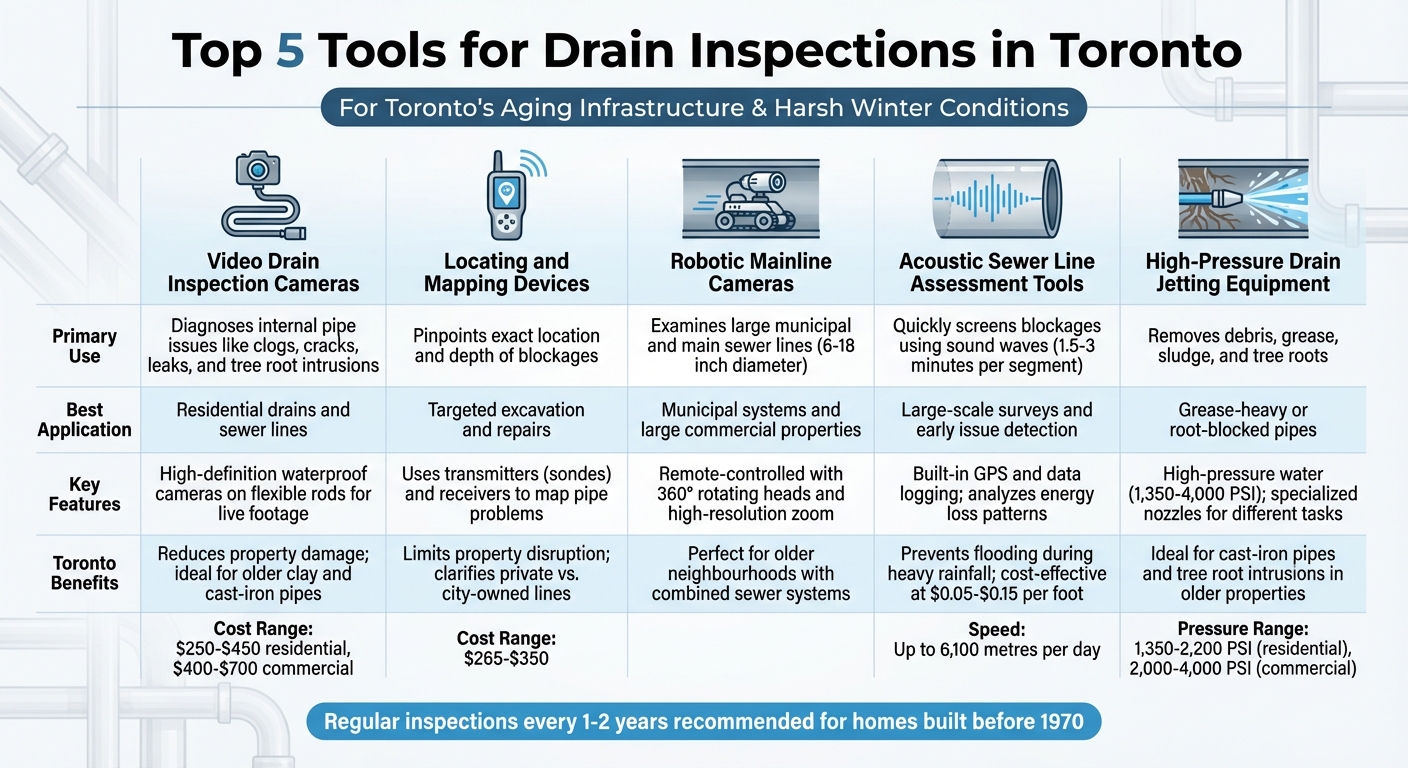
Comparison of 5 Drain Inspection Tools for Toronto Properties
1. Video Drain Inspection Cameras
Primary Use
Video drain inspection cameras are an essential tool for diagnosing hidden plumbing problems like tree root intrusions, grease buildup, corrosion, and cracks - without causing any damage to your property. They’re particularly useful for pre-purchase inspections in Toronto's older homes, which often feature fragile clay pipes that can develop stress fractures over time. These cameras also confirm the success of drain cleaning, evaluate whether a property is ready for renovations, and even help recover lost items.
Their ability to adapt to different property types makes them a go-to solution for a wide range of plumbing challenges.
Best Fit (Residential, Commercial, or Municipal)
While these cameras are commonly used by homeowners - especially those with older properties - they’re equally valuable for commercial spaces like restaurants or offices that deal with grease buildup and heavy plumbing use.
Key Features
Modern drain cameras are equipped with advanced features that make them highly effective for diagnosing plumbing issues in Toronto's diverse systems.
- High-definition, waterproof cameras mounted on flexible fibre-optic cables can navigate tight bends with ease.
- A real-time video feed lets both the technician and property owner see the problem as it’s found, thanks to a monitor above ground.
- Signal transmitters (sondes) pinpoint the exact location and depth of the issue, which helps repair teams know where to dig - if digging is even required.
- Many systems include digital recording and imaging, offering detailed reports that can be used for insurance claims, real estate negotiations, or planning future repairs.
"With a drain camera inspection in Toronto, you can now see exactly what's happening inside your plumbing system without digging, breaking tiles, or tearing down drywall." – Premier Plumbing
Benefits for Toronto Properties
Toronto’s aging infrastructure and harsh winters create unique plumbing challenges, and these cameras provide critical insights. A typical inspection takes about 30–60 minutes and costs between $250–$450 for residential properties, while condos or commercial spaces may range from $400–$700. Compared to traditional methods that require excavation and restoration, this non-invasive approach is significantly more affordable.
If you’re applying for the City of Toronto’s Basement Flooding Protection Subsidy Program, camera footage serves as the visual proof needed to qualify for rebates on backwater valve installations. Additionally, some local plumbing companies offer warranties of up to 25 years on drain repairs following a professional camera inspection.
sbb-itb-466cac3
2. Locating and Mapping Devices
Primary Use
Locating and mapping devices work hand-in-hand with video cameras to identify the exact location and depth of pipes hidden underground or behind walls. These tools rely on a transmitter, often called a sonde, which is built into the camera head. Aboveground, a technician uses a handheld receiver to trace the signal from the sonde. Together with drain cameras, these devices pinpoint issues, allowing for precise repairs without unnecessary digging or demolition. This means you won’t need to tear up your yard or rip out drywall just to locate a problem. They’re especially useful for spotting issues like tree root intrusions, collapsed pipe sections, or pipe sags (known as bellies). By combining visual inspections with accurate mapping, repairs can be carried out with precision.
Best Fit (Residential, Commercial, or Municipal)
These tools are incredibly versatile and serve various property types across Toronto. For residential properties, they’re particularly helpful in older homes - those over 20 years old - that may have clay or cast-iron pipes showing signs of wear. They’re also a smart choice for prospective homebuyers who want a sewer inspection before finalizing a purchase. In commercial and municipal settings, these devices play a key role in large-scale infrastructure projects. Utility mapping, often enhanced by Ground Penetrating Radar (GPR), is used for inspecting mainline pipes ranging from 4 to 87 inches in diameter.
Key Features
The sonde transmitter emits a signal from inside the pipe, which the handheld receiver detects, allowing technicians to mark the exact repair location - even beneath concrete or deep soil. Many systems include depth indicators, which help estimate excavation costs accurately. Additionally, these tools trace the pipe’s path, showing turns and connections to guide repairs and avoid accidental damage during renovations. They’re also invaluable for identifying illegal pipe connections.
"The camera allows plumbers to pinpoint what needs to be replaced and how long the damaged section is. This drastically brings down costs for homeowners because the guesswork has been taken out of the equation." – DrainWorks Plumbing
Benefits for Toronto Properties
In Toronto, a professional plumbing camera inspection, which often includes locating services, typically costs between $265 and $350. Unlike older, invasive methods, these devices minimize disruption to your property. Many Toronto homes have combined sanitary and storm sewer systems, making accurate mapping essential for assessing flood risks and protecting basements from water damage. If a plumber marks a problem area with tape or flags, don’t move them - they indicate the exact spot for excavation or repair.
3. Robotic Mainline Cameras
Primary Use
Robotic mainline cameras are designed to inspect large sewer and stormwater lines running between manholes. These sturdy devices can handle pipes with diameters starting at 6 inches and going up to 18 inches, depending on the model. They’re often paired with high-pressure hydro jetting to confirm that the lines have been thoroughly cleaned. Their advanced imaging capabilities allow them to detect issues like calcified deposits, blockages, cracks, or misaligned joints.
"Attempting to clean drain lines 'blind,' without the aid of a camera, is considerably less efficient and may leave underlying issues unaddressed." – Trouble Shooters
Best Fit (Residential, Commercial, or Municipal)
Robotic mainline cameras go beyond the functionality of standard inspection cameras, making them ideal for larger and more intricate systems. They’re most commonly used in commercial and municipal settings, where the drainage networks are extensive and complex. In Toronto, for example, they play a critical role in inspecting city-managed storm and sanitary sewers, large commercial properties, and restaurants that frequently deal with calcified grease buildup.
In residential settings, these cameras are typically reserved for larger estate homes or for examining the main sewer lines connecting a property to the municipal system. In older Toronto neighbourhoods with combined sanitary and storm sewers, these inspections are especially valuable in preventing basement flooding during heavy rain events.
Key Features
Robotic mainline cameras are controlled remotely from a central station, giving technicians precise navigation through sprawling pipe systems. Equipped with rotating camera heads that offer a full 360° view, they provide detailed images of pipe walls, joints, and branching lines. High-resolution lenses with zoom functions allow inspectors to zero in on small defects, such as hairline cracks, while built-in lighting ensures clear visibility, even in large-diameter pipes.
Benefits for Toronto Properties
Toronto’s aging infrastructure, particularly homes built before 1980 with clay pipes that are prone to brittleness and fractures, greatly benefits from robotic mainline inspections. These cameras provide clear visuals and pinpoint the exact location of issues, helping property owners avoid the expense and disruption of unnecessary excavation. This is especially valuable for commercial, municipal, or estate properties with larger pipe systems. Additionally, post-hydro jetting inspections verify that blockages have been fully cleared and that the pipe’s structure remains intact.
4. Acoustic Sewer Line Assessment Tools
Primary Use
Acoustic tools are designed to send sound waves through pipes, making it possible to detect blockages without the need for invasive inspections. By measuring how much energy is obstructed by things like roots, grease, debris, or joint misalignments, these tools can quickly identify problem areas. Each pipe segment can be assessed in just 1.5 to 3 minutes, making this method an efficient way to determine which sections need further investigation using tools like CCTV or high-pressure jetting.
"Acoustic inspection gives your team a clear signal of where to clean - and where not to." – InfoSense
Best Fit (Residential, Commercial, or Municipal)
Acoustic assessment tools shine in municipal and large commercial settings, particularly for monitoring extensive sewer networks with pipe diameters ranging from 6 to 18 inches. Unlike visual inspection tools, acoustic methods can quickly scan large areas, helping teams pinpoint where to focus their efforts. Under ideal conditions, a two-person crew can inspect up to 6,100 metres in a single day. This speed and efficiency make it easier for utilities to move away from rigid cleaning schedules and adopt a more flexible, condition-based maintenance strategy. Acoustic screening works hand-in-hand with visual inspections, flagging areas that need a closer look.
Key Features
Modern acoustic tools come equipped with advanced features like built-in data logging and GPS, which automatically record blockage scores for mapping and reporting purposes. Sophisticated algorithms analyse energy loss to determine the severity of obstructions. Since the assessments are conducted from the surface, there’s no need for confined-space entry, significantly reducing exposure to wastewater.
Benefits for Toronto Properties
The operational cost for acoustic sewer assessments averages less than $0.10 per foot (or about $0.30 per metre), with costs varying between $0.05 and $0.15 per foot depending on labour factors. In Toronto’s older neighbourhoods, where tree roots and aging pipes are common culprits, these tools provide an affordable and proactive way to prevent emergency backups and basement flooding.
"The SL-RAT has been extremely helpful for evaluating pipes located in areas that our CCTV trucks cannot reach." – Spring Quin, Engineering Technologist III, City of Campbell River
5. High-Pressure Drain Jetting Equipment
Primary Use
High-pressure drain jetting, also known as hydro jetting, uses powerful water streams to clear stubborn clogs that traditional drain snakes can't tackle. This includes hardened grease, sludge build-up, tree roots, and even foreign objects lodged deep in pipes. In Toronto's commercial spaces, like restaurants, grease from food waste often solidifies on pipe walls, making jetting essential for thorough cleaning. Plumbers often combine jetting with camera inspections to ensure the blockage is fully cleared and to check for hidden issues such as cracks or misaligned joints.
"Primarily used alongside high-pressure jetting, our robotic camera also verifies whether your lines have been thoroughly cleaned." – Trouble Shooters
Best Fit (Residential, Commercial, or Municipal)
Jetting tools are chosen based on the type of property and the severity of the blockage. For residential properties, compact units are ideal for clearing sink traps and indoor drains. These portable jetters, powered by electricity or gas, typically operate at pressures between 1,350 and 2,200 PSI. On the other hand, commercial and municipal applications require heavy-duty trailer-mounted jetters. These units deliver pressures of 2,000–4,000 PSI and flow rates of 18–35 GPM, making them capable of handling large sewer and storm lines, including pipes as wide as 87 inches.
"Trailer mounted jetters will handle just about any clog that gets in your way... specifications ranging from 2,000 to 4,000 PSI and 18 to 35 GPM." – Spartan Tool
Key Features
Modern jetting equipment comes with specialized nozzles designed for different tasks. Penetrating nozzles, angled at 30 degrees, cut through tough blockages, while spinning nozzles clean pipe walls thoroughly. Drop-head nozzles are perfect for navigating tight bends in plumbing systems. Many units also include pulse technology, which helps hoses move through sharp corners and traps. For Toronto’s cold winters, equipment with air-purge systems is essential to prevent freezing during service calls.
The cost of nozzles ranges from $65 to $270, while complete jetting systems start at around $3,645 for basic residential models and can exceed $10,000 for commercial-grade units. These features make jetting equipment versatile and effective for Toronto’s diverse drainage systems.
Benefits for Toronto Properties
Toronto’s older clay and cast-iron pipes greatly benefit from hydro jetting. It restores flow capacity by thoroughly cleaning pipe walls without relying on harsh chemicals, making it an environmentally friendly solution. Jetting also eliminates the need for invasive methods, as blockages can be cleared from access points without tearing into walls or floors. Regular jetting helps prevent common issues in Toronto’s older neighbourhoods, such as grease build-up leading to sewage backups or basement flooding.
How to Use a Sewer Camera | Plumbing Basics
Tool Comparison Table
Here’s a quick overview of the five tools discussed in this article, highlighting their main uses, ideal applications, and benefits for properties in Toronto.
| Tool | Primary Use | Best Application Type | Main Features | Toronto-Specific Benefits |
|---|---|---|---|---|
| Video Drain Inspection Cameras | Diagnoses internal pipe issues like clogs, cracks, leaks, and tree root intrusions | Residential drains and sewer lines | Equipped with high-definition, waterproof cameras on flexible rods for live footage | Reduces damage to walls and landscaping; especially useful for older clay and cast-iron pipes |
| Locating and Mapping Devices | Pinpoints the exact location and depth of blockages | Targeted excavation and repairs | Uses transmitters and receivers to map pipe problems | Limits property disruption and clarifies private vs. city-owned lines |
| Robotic Mainline Cameras | Examines large municipal and main sewer lines | Municipal systems and large commercial properties | CCTV systems designed to detect structural damage | Perfect for older neighbourhoods with combined sewer systems |
| Acoustic Sewer Line Assessment Tools | Quickly screens blockages using sound waves | Large-scale surveys and early issue detection | Detects gurgling or bubbling sounds caused by trapped air | Helps prevent flooding during heavy rainfall |
| High-Pressure Drain Jetting Equipment | Removes debris, grease, sludge, and tree roots | Clears grease-heavy or root-blocked pipes | Utilizes high-pressure water to eliminate blockages | Ideal for cleaning cast-iron pipes and tackling tree root intrusions, especially in older properties and restaurants |
These tools are carefully designed to handle Toronto’s unique drainage challenges, promoting efficient maintenance and cost-effective repairs. For routine residential inspections, video cameras are a top pick, while robotic systems are better suited for the city’s aging municipal infrastructure. Locating devices reduce unnecessary digging, saving both time and money. High-pressure jetting is excellent for tackling stubborn blockages, and when combined with video inspections, it provides a thorough solution for properties with mature trees or older systems.
Conclusion
Modern drain inspection technologies have revolutionized the way plumbing issues are identified and resolved. Gone are the days of unnecessary digging, damaged lawns, and costly trial-and-error repairs. As outlined earlier, professional inspections can uncover hidden problems like tree root invasions, pipe corrosion, or misaligned segments long before they escalate into major headaches like sewage backups or basement flooding. These accurate diagnostics not only protect your property but also save you money in the long run.
Think of a thorough diagnostic inspection as a safeguard against repair costs that can skyrocket beyond $15,000. As Master Drain aptly puts it:
"Deciding on a drain camera inspection is not about fixing a problem today; it's about preventing a financial catastrophe tomorrow."
For Toronto homeowners, especially those with properties built before 1970 that often feature clay pipes vulnerable to freeze-thaw cycles, regular inspections every one to two years can catch small issues before they turn into emergencies.
These inspections do more than just prevent damage - they also enhance property value and simplify maintenance. Licensed professionals, like those at Creed Plumbing, provide detailed documentation that can be invaluable for insurance claims, real estate transactions, or future repairs. A well-documented inspection history can make your property more appealing to buyers. Additionally, Toronto’s Basement Flooding Protection Subsidy Program offers financial assistance for qualifying repairs, easing the burden on homeowners. For those in the market for a new home, a pre-purchase sewer scope can reveal the true state of a property’s underground systems, helping you avoid costly surprises.
Creed Plumbing employs these cutting-edge tools to deliver precise diagnostics and transparent service. They ensure you receive detailed reports and video evidence, which are essential for insurance purposes or long-term maintenance planning. Always insist on copies of the raw video footage and written inspection reports for your permanent records. If a company refuses to provide this documentation, consider it a warning sign.
Whether you’re maintaining an older home in The Annex, managing a commercial property downtown, or preparing for a property sale, advanced inspection tools offer peace of mind. They deliver accuracy, efficiency, and non-invasive solutions that protect both your property and your finances.
FAQs
How can video drain inspection cameras save homeowners in Toronto money?
Video drain inspection cameras offer a clear, real-time look at problems such as blockages, cracks, or tree roots invading your pipes. With this technology, homeowners can pinpoint the exact location and cause of an issue, avoiding the hassle of unnecessary repairs or large-scale digging.
Catching problems early helps you sidestep significant damage that might otherwise require expensive pipe replacements or urgent repairs. It’s a smart way to save money and reduce disruptions to your home or property.
What are the advantages of using locating and mapping tools for older homes in Toronto?
Locating and mapping tools like utility locators, transmitters, and ground-penetrating radar (GPR) are essential for homeowners in Toronto to pinpoint the exact location of buried or hidden pipes before starting any work. This is especially critical for older homes, as it helps avoid accidental damage to historic foundations, minimizes the risk of expensive repairs, and ensures safety during renovations.
These tools generate detailed maps of drain lines, water supply pipes, and older materials such as cast iron or clay. This allows for precise repairs with minimal disruption to the property. When paired with advanced camera systems, plumbers can inspect the inside of pipes to identify issues like blockages or corrosion and verify that repairs have been successful. This method not only saves time and money but also helps maintain the structural integrity of older homes.
Why is high-pressure drain jetting ideal for commercial properties in Toronto?
High-pressure drain jetting is a go-to solution for commercial properties in Toronto, especially when dealing with tough blockages like grease build-up, scale, or even tree roots in large sewer lines. It works fast to restore proper drainage, helping businesses avoid recurring problems and costly disruptions.
With the use of powerful water jets, this method offers a deep clean without harming the pipes. It's a dependable and environmentally friendly way to keep commercial drainage systems running smoothly.