Basement flooding in Toronto is a growing issue, especially with increasing rainfall and aging infrastructure. Here’s what you need to know:
- Flooding Risks: Toronto receives 831 mm of precipitation annually, and urbanization limits natural water absorption. Flooding often results from overwhelmed drainage systems, rapid snowmelt, and power outages during storms.
- Sump Pump Backups: A primary sump pump removes groundwater, but it fails during power outages. Backup systems, powered by batteries or municipal water, ensure continuous operation and protect your basement.
- Subsidy Program: Toronto offers financial support to homeowners for installing sump pump backups. Starting May 2026, subsidies will increase to $6,650 per property, including $300 for battery backups.
- Maintenance: Regular checks and professional inspections are crucial. Clean your pump yearly, test it monthly, and replace batteries every 3–10 years.
Flood prevention is an investment that saves you from costly repairs. Equip your home with a backup sump pump and take advantage of Toronto’s subsidy program to protect your property.
How to Install a Battery-Operated Backup Sump Pump | This Old House
How Backup Sump Pumps Prevent Basement Flooding
Primary sump pumps are the workhorses of basement water management, handling everyday tasks like removing groundwater and managing moderate rainfall. These pumps, commonly found in residential settings, can move between 2,000 and 5,000 gallons of water per hour. Installed in a sump pit beneath the basement floor, they rely on a float switch to activate when water levels rise to a certain point. Once triggered, an impeller pushes water through a discharge pipe, directing it to a safe distance - at least 2 metres - from the home's foundation.
Backup systems add an extra layer of protection. Positioned in the same sump pit but with a float switch set at a higher level, these systems kick in automatically if the primary pump fails. Failures can happen for various reasons, including mechanical breakdowns, power outages, or an overwhelming inflow of water. Toronto's clay-heavy soil, notorious for poor drainage, adds to the challenge. During heavy summer thunderstorms or spring snowmelts, hydrostatic pressure builds up, forcing water through foundation cracks. In such cases, a backup system can be a lifesaver, especially during storms that can fill a sump pit in under 20 minutes.
"A backup system gives you peace of mind, knowing you're protected even if your main pump falters."
- Priority Plumbing & Drains
A critical weakness of primary sump pumps is their reliance on electricity. When power outages strike - especially during storms - they stop working entirely. Between 2014 and 2023, weather-related power outages nearly doubled compared to those recorded from 2000 to 2009. This is where backup systems, powered by batteries or municipal water pressure, show their value. They operate independently of the electrical grid, keeping your basement dry even when the lights go out.
Backup System Performance During Power Outages
Battery backup systems are a reliable option, offering solid pumping capabilities and typically providing 24 to 36 hours of continuous operation. The actual runtime depends on how often the pump cycles and the rate of water inflow. For instance, the UltraSump 4 can pump up to 12,000 gallons on a fully charged battery, and dual-battery setups can double that capacity.
Water-powered backup pumps, on the other hand, use municipal water pressure to function. Through the Venturi effect, they create suction to remove water from the sump pit. These systems can remove 2 gallons of sump water for every gallon of municipal water used. Their standout feature is unlimited runtime - provided the municipal water supply maintains a pressure of at least 40 psi. However, extended use can lead to higher water bills.
Both battery and water-powered systems are designed to activate automatically when water levels exceed the primary pump's capacity. This ensures your home remains protected, even if you're away or asleep during a storm. These features make backup systems a critical component of flood prevention, especially in areas like Toronto where extreme weather events are becoming more frequent.
Toronto Flood Prevention Examples
Recent weather events in Toronto have highlighted just how important backup sump pumps are. Take July 2024, for example, when the city experienced its wettest July in 70 years, with over 215 mm of rain recorded. On 16 July alone, more than 100 mm of rain fell in just three hours, overwhelming drainage systems. In such crises, Toronto emergency plumbing services become vital for immediate intervention. The result? Over 1,000 homes faced basement flooding. However, properties equipped with functioning backup sump pumps had a better chance of staying dry, even as power outages rendered many primary pumps useless.
"Toronto's weather patterns make basement flooding a constant threat. Clay soil, spring runoff, and summer storms all conspire to put water where you don't want it."
With roughly 60% of homes in Toronto dealing with below-ground moisture issues, and risks compounded by the city's aging infrastructure and high water tables, backup sump pump systems have gone from being optional extras to essential tools for safeguarding homes and investments.
Toronto's Basement Flooding Protection Subsidy Program
The City of Toronto is helping homeowners take proactive steps to guard against basement flooding by offering financial incentives for installing reliable sump pump backup systems and other flood prevention measures.
Since 2007, the Basement Flooding Protection Subsidy Program has provided support for installing sump pumps, backwater valves, and similar devices. To date, the program has received around 59,000 applications and has issued nearly $86 million in subsidies. Approximately 14% of residential properties in Toronto have benefited from this initiative.
Eligibility is simple. To qualify, you must own a single-family home, duplex, triplex, or fourplex in Toronto. Properties under construction do not qualify. Applicants must also disconnect their downspouts from the City’s sewer system (or secure an exemption), comply with zoning bylaws for front yard paving, and ensure no outstanding taxes or debts are owed to the City. Additionally, all installation work must be performed by a contractor with a valid City of Toronto business licence. These requirements ensure that the subsidies are directed to eligible homeowners while reflecting current costs and inflation.
2025 Program Updates and Subsidy Amounts
After heavy storms in July 2024 flooded over 1,000 homes in Toronto, the City announced major updates to the program. Starting in May 2026, the maximum subsidy per property will increase from $3,400 to $6,650. Subsidies for individual devices will also rise by 28% to keep pace with inflation. A new $300 subsidy will be introduced specifically for sump pump battery backup systems, including retrofits to existing setups. Currently, the program covers 80% of installation costs, up to $1,750 for sump pumps and $1,250 for backwater valves.
"Sump pumps and backwater valves might be the last thing on the mind for a family struggling to make ends meet, but a flood in your basement can be devastating. The Enhanced Basement Protection Subsidy Program will get homeowners up to $6,650 so they can afford to protect their homes and their families from the next big storm."
- Olivia Chow, Mayor of Toronto
How to Apply for Subsidies
Before starting any work, ensure your contractor has a valid City of Toronto business licence. You can verify this through the Business Licence Lookup tool or by calling 416-392-6700. For backwater valve installations, a Building Permit is required. Starting 12 January 2026, permit applications must be submitted through the City’s Online Services platform. The permit fee is $38.67.
Once the installation is complete, gather the following documents: itemized invoices marked "paid in full", photos of the sump pump and exterior discharge pipe, and the permit number. Submit your application online through the City of Toronto’s website. Applications must be submitted within one year of the installation’s completion, but this window will extend to two years beginning 1 May 2026. Processing typically takes up to 10 weeks.
One key point: if you’re installing a backwater valve, do not cover or enclose it until a Toronto Building staff member has conducted the required inspection. This step ensures the device complies with Building Code standards and is essential for subsidy approval.
sbb-itb-466cac3
Battery vs. Generator Backup Systems
Battery vs Generator Sump Pump Backup Systems Comparison
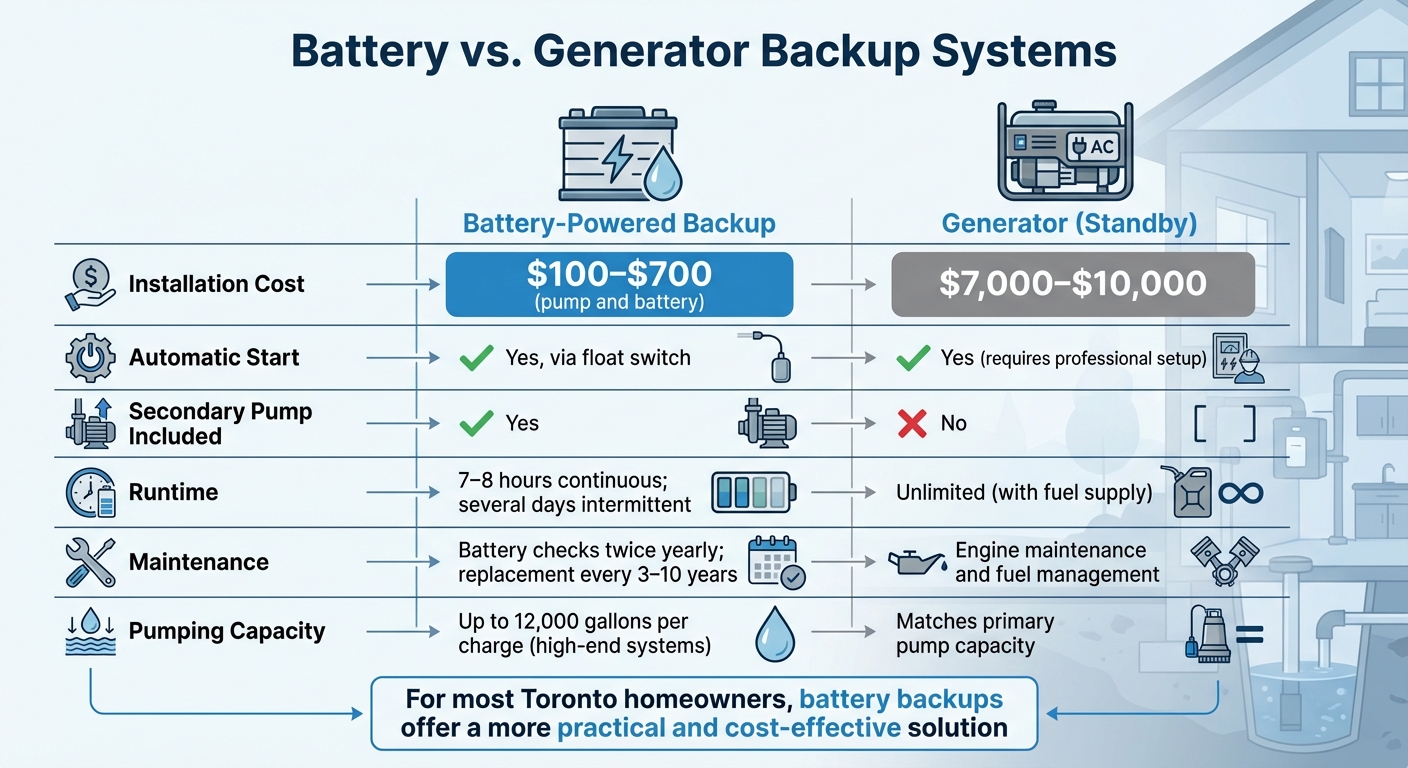
When a primary sump pump fails during a storm, having an automatic backup system is essential for protecting your home. In Toronto, homeowners often choose between two popular options: battery-powered backups and generator systems. Each comes with its own set of advantages, making the choice dependent on specific needs and circumstances.
Battery backups are designed to kick in immediately when needed. They rely on a float switch to activate and come equipped with a secondary pump, offering protection against both power outages and mechanical failures. On the other hand, generator systems provide power to the primary pump but do not include a secondary pump.
Here’s a quick breakdown of how these two systems compare:
Comparison Table: Features, Costs, and Maintenance
| Feature | Battery-Powered Backup | Generator (Standby) |
|---|---|---|
| Installation Cost | $100–$700 (pump and battery) | $7,000–$10,000 |
| Automatic Start | Yes, via float switch | Yes (requires professional setup) |
| Secondary Pump Included | Yes | No |
| Runtime | 7–8 hours continuous; several days intermittent | Unlimited (with fuel supply) |
| Maintenance | Battery checks twice yearly; replacement every 3–10 years | Engine maintenance and fuel management |
| Pumping Capacity | Up to 12,000 gallons per charge (high-end systems) | Matches primary pump capacity |
Key Considerations: Longevity and Maintenance
Beyond the upfront costs, the lifespan and maintenance requirements of these systems play a big role in deciding which is the better fit. Battery systems, especially those using LiFePO₄ cells, can last up to 10 years with over 3,000 charge cycles. In contrast, traditional lead-acid batteries need replacement every 3–5 years. Standby generators, while more durable (lasting 15+ years with proper care), come with higher initial expenses and require professional installation.
Best Backup Systems for Toronto Homes
For most Toronto homeowners, battery backups offer a more practical and cost-effective solution. They’re easier to install - often a DIY project - and are specifically designed to handle the most common sump pump failure scenarios. For example, during Toronto’s July 2024 storms, when over 215 mm of rain fell in one month (including 100 mm in just three hours), sump pits filled in under 20 minutes if pumps weren’t working. High-quality battery systems, like the UltraSump 4, can pump up to 12,000 gallons on a single charge, providing reliable protection.
Generators, while better suited for extended power outages or homes with multiple appliances to run, require a much larger investment and professional setup. For those who experience frequent but shorter outages, a battery-powered system is often the better choice.
Sump Pump Maintenance for Long-Term Performance
Keeping your sump pump in good working order is crucial for flood prevention, especially in Toronto homes where heavy rains can overwhelm systems. With proper care, a sump pump can last between 7 and 10 years. The importance of maintenance became starkly clear after Toronto's 2013 ice storm, where sump pump failures accounted for nearly half of the $225 million in insurance claims.
Regular Maintenance Tasks and Testing
Routine checks can help you catch issues before they turn into costly problems. A simple monthly test involves pouring about five gallons of water into the sump pit to ensure the float switch activates the pump and drains the water quickly. Every three months, take a closer look at the inlet screen to remove any debris and confirm that your GFCI outlet is functioning properly.
Once a year, give your sump pump a thorough cleaning. Unplug the unit, remove it from the pit, and rinse both the pump and the inlet screen. A vinegar and water solution works well to clear out any sludge. Check the discharge line for cracks or blockages and make sure it directs water at least 6 metres (20 feet) away from your home's foundation to prevent water recycling back into your basement.
If your system includes a battery backup, there are additional steps to follow. Check water levels in the battery every few months, clean the terminals twice a year, and replace the battery every five years. Before winter hits, clear snow and ice from the discharge pipe's exit to prevent freezing, which can cause water to back up into the pit and lead to an overflow.
If you notice anything unusual during your checks - like strange noises or inconsistent performance - it’s a good idea to call in a professional.
When to Call a Professional
Sometimes, even with regular maintenance, sump pumps start acting up. If you hear grinding, rattling, or loud humming noises, it could mean the bearings are worn or the impeller is damaged. A pump that runs non-stop despite low water levels or cycles on and off too quickly might have a faulty float switch or check valve. Visible rust, corrosion, or oil in the sump pit is another red flag, indicating worn seals and a pump nearing the end of its lifespan.
"A sump pump is one of the most important (and ignored) disaster prevention devices in a home." - Family Handyman
Professional maintenance and inspections in Toronto typically cost between $150 and $300 per year. This expense is minor compared to the potential cost of water damage, as mould can begin growing within 24 to 48 hours of exposure. If your sump pump is over seven years old, consider having it inspected or replaced before the next major storm hits.
For reliable sump pump maintenance and emergency repairs in Toronto, you can reach out to Creed Plumbing. Their expertise can help ensure your system stays in top shape and ready to handle whatever the weather throws at it.
Conclusion: Protecting Your Home with Backup Sump Pumps
Basement flooding isn’t just an inconvenience - it’s an expensive problem that can be avoided with the right precautions. By combining backup sump pump systems, consistent maintenance, and taking advantage of financial support programs, Toronto homeowners can greatly reduce the risk of costly water damage. Considering that the average cost to clean up a flooded basement often exceeds $10,000, prevention is undeniably the smarter investment.
Toronto’s Basement Flooding Protection Subsidy Program has been a game-changer for many. Since 2007, the program has provided nearly $86 million in support, benefiting 14% of residential properties. Even better, starting 1 May 2026, the subsidies will increase significantly. Homeowners can receive up to $6,650 (up from $3,400), along with a new $300 incentive for battery backup systems.
"The Enhanced Basement Protection Subsidy Program will get homeowners up to $6,650 so they can afford to protect their homes and their families from the next big storm."
- Mayor Olivia Chow
The extreme rainfall events during July and August 2024 were a stark reminder of how unpredictable weather has become. With storms growing more severe, having a reliable backup sump pump system is essential. Regular testing and professional inspections add an extra layer of security, especially during power outages.
Don’t wait for the next big storm to take action. Install a backup system, apply for the available subsidies, or schedule maintenance with Creed Plumbing today. A small investment now can save you from the financial and emotional toll of a flooded basement. Protect your home and your peace of mind - act today.
FAQs
What are the advantages of having a backup sump pump in Toronto homes?
A backup sump pump provides essential flood protection for homeowners in Toronto, especially during heavy rainstorms or power outages. It kicks in automatically if the main pump fails or can't keep up, reducing the risk of basement flooding, water damage, and expensive repairs.
This extra safeguard helps keep your home dry and protected, even when the weather takes a turn for the worse. With Toronto's unpredictable climate, having a backup sump pump is a practical way to protect your property and maintain peace of mind.
What is the Basement Flooding Protection Subsidy Program in Toronto, and how does it work?
The Basement Flooding Protection Subsidy Program is a City of Toronto initiative designed to help homeowners reduce the risk of basement flooding. The program provides financial support for installing flood prevention measures such as backwater valves, sump pumps, and storm-sewer capping. It’s open to owners of single-family homes, duplexes, triplexes, and four-plexes.
Homeowners may qualify for up to $3,400 CAD per property, covering 80% of approved costs within set limits: up to $1,250 for a backwater valve, $1,750 for a sump pump, $2,800 for both devices, and $400 for pipe capping or severance. To be eligible, the work must be carried out by a licensed plumber, and claims need to be submitted within one year of the installation date.
For professional help, Creed Plumbing, a licensed and insured Toronto-based plumbing service, can manage the installation and ensure your application meets all the program's guidelines. The City is also exploring program updates for 2026, which may include higher subsidy amounts and additional eligible devices like battery backups.
What maintenance does a sump pump backup system need to stay reliable?
Regular upkeep is key to keeping your sump pump backup system ready to perform, particularly during Toronto’s heavy rains or power outages. Every three months, test the system by filling the sump pit with water. Make sure the primary pump activates as expected. Then, disconnect the power to confirm the backup pump kicks in and empties the pit properly. Don’t forget to check that the float switch moves freely and that the backup alarm (if your system has one) is working.
Pay close attention to the battery. Most deep-cycle or sealed lead-acid batteries start losing capacity after 3–5 years, so it’s wise to replace them before they fail. Clean the battery terminals, tighten all connections, and keep the area dry. If you’re using a wet-cell battery, top it up with distilled water when necessary. It’s also a good idea to clean out the sump pit and intake valve to remove any debris like sediment or leaves. While you’re at it, inspect the discharge pipe for cracks or clogs, and make sure it directs water at least 3 metres away from your home’s foundation to protect against flooding.
For extra assurance, book an annual inspection with a licensed plumber. Creed Plumbing provides expert sump pump maintenance services in Toronto, helping ensure your system is ready to handle the city’s unpredictable weather and power outages.