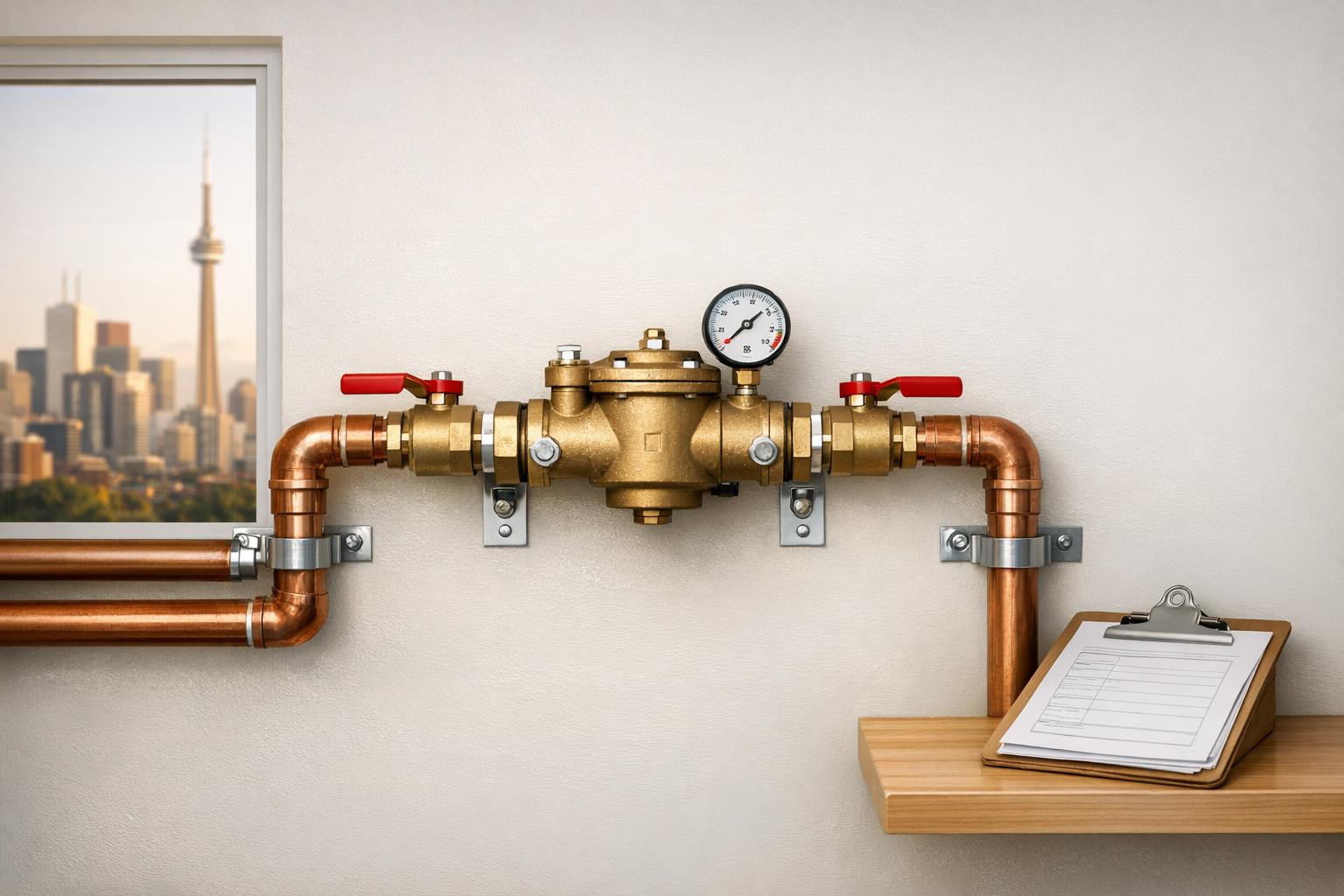

Backflow prevention is essential to keep Toronto’s water supply safe. It stops contaminants from entering the municipal system when water flows in the wrong direction. Toronto enforces strict regulations, requiring specific devices for industrial, commercial, institutional, and larger residential properties. Here’s what you need to know:
- What causes backflow? It happens due to back pressure (higher private system pressure) or back siphonage (municipal pressure drops).
- Devices required: Types like Double Check Valve Assemblies (DCVA) or Reduced Pressure (RP) devices are mandated based on property risk levels.
- Annual testing: Devices must be tested yearly and after maintenance by certified professionals.
- Compliance: Starting January 1, 2026, a $92.79 permit fee applies for device testing. Records must be kept on-site for seven years.
Toronto’s Water Supply By-law ensures clean water access for everyone. Proper installation, maintenance, and testing of backflow devices are crucial to meet these rules and protect public health.

Toronto Backflow Prevention Compliance Process: Installation, Testing & Maintenance Requirements
How it Works Backflow Preventer | Plumbing 101
sbb-itb-466cac3
Toronto Backflow Prevention Regulations
Toronto Water enforces backflow prevention rules under the Water Supply By-law (Municipal Code, Chapter 851). This by-law outlines the responsibilities of both property owners and the City to safeguard the municipal drinking water system from contamination. It’s important to understand which properties are affected and how the regulations apply to ensure compliance, avoid penalties, and protect Toronto’s water supply.
Who Needs Backflow Prevention Devices?
Not all properties in Toronto require backflow prevention devices. According to the by-law, these devices are mandatory for industrial, commercial, institutional (ICI), Part 3 residential properties, and construction sites. Standard single-family homes are exempt, but larger multi-unit residential buildings classified as "Part 3" under the Ontario Building Code must meet the same requirements as commercial properties.
The type of device needed depends on the hazard level of your property, as outlined in Schedule 5.
For example, the University of Toronto’s St. George campus provides a clear example of compliance. As of 2026, the university has installed backflow prevention devices across various campus buildings. In facilities with only one domestic water backflow preventer - such as the Goldring Centre for High Performance Sport and the Myhal Centre for Engineering Innovation and Entrepreneurship - testing is scheduled during off-peak hours, typically before 6:00 AM or after 11:00 PM, to minimise disruptions caused by water shut-offs.
Toronto Water By-Laws Explained
Once you determine whether your property requires a backflow prevention device, it’s essential to understand the procedures for compliance. The Water Supply By-law enforces strict guidelines, including annual testing, initial installation tests, and post-maintenance tests. Certified professionals must submit test reports online, with immediate confirmation provided via email.
Property owners are also required to complete a Backflow Prevention Survey every five years - or within 30 days if a property’s hazard level increases. All test reports must be submitted online, and records must be kept on-site for at least seven years. Additionally, any changes in tenants or operations that affect your building’s hazard level must be reported to Toronto Water within 30 days, as this may require a different prevention device.
Only plumbers who are licensed with the City of Toronto and certified as Cross Connection Control Specialists are allowed to install or test these devices. For new installations or replacements, a building permit is required, with a fee of $92.79 per device starting 1 January 2026. Your plumber will handle the permit application process on your behalf.
Types of Backflow Prevention Devices
Choosing the right backflow prevention device depends on your property's hazard classification and the potential risk of contamination. Each situation demands a specific device to ensure compliance and safeguard the municipal water supply. Here’s a breakdown of the primary devices commonly used in Toronto, customized for different hazard levels.
Double Check Valve Assembly (DCVA)
The Double Check Valve Assembly (DCVA) is designed for moderate hazard scenarios. It includes two spring-loaded check valves, two shut-off valves, and four test cocks. This device offers protection against back-pressure (when downstream pressure exceeds supply pressure) and back-siphonage (when negative pressure occurs in the supply line).
DCVAs are typically required in facilities like hotels, apartments with five or more units, dental clinics, funeral homes, and nursing homes. They are also commonly used in fire sprinkler systems and lawn irrigation systems. Since DCVAs do not have visible failure indicators, annual testing by certified professionals is mandatory.
Reduced Pressure Principle Assembly (RP)
For properties classified as high hazard, a more advanced device is necessary. Toronto mandates the use of the Reduced Pressure Principle Assembly (RP or RPZ) for these situations. This device provides maximum mechanical protection with two check valves separated by a pressure-monitored zone and a relief valve. If a check valve leaks or pressure changes occur, the relief port discharges water, offering a visible alert of malfunction.
RP devices are required in high-risk facilities such as hospitals, car washes, chemical plants, meat processing plants, wastewater treatment facilities, and laboratories. Due to their design, these devices periodically release water during normal pressure fluctuations. As a result, they must be installed in areas with proper drainage, such as near a floor drain or with a piped discharge to a sanitary sewer. Toronto regulations prohibit installing RP devices below grade in pits, chambers, or vaults, and they must be positioned at least 12 inches (30.5 cm) above the floor or grade to ensure proper drainage and functionality of the relief valve.
Other Backflow Prevention Options
Several other devices offer alternative protection methods:
- Air Gaps: This non-mechanical option provides the highest protection by physically separating the water discharge point from the receiving vessel. The gap must be at least twice the diameter of the supply pipe and no less than 1 inch (2.5 cm). While highly effective, air gaps can be impractical in some setups.
- Pressure Vacuum Breaker (PVB): Equipped with a spring-loaded check valve and an independent air inlet valve, PVBs are designed for continuous pressure applications like residential irrigation systems. However, they only protect against back-siphonage, not back-pressure, and must be installed at least 12 inches (30.5 cm) above downstream piping.
- Atmospheric Vacuum Breaker (AVB): This device uses a float and spring mechanism but cannot handle continuous pressure. It’s suitable for simple, low-hazard applications.
- Dual Check Valves: These are similar to DCVAs but lack test cocks and shut-off valves. They are primarily used for single-family home water service connections where the hazard level is low.
Understanding the specific functions and requirements of these devices ensures proper installation and long-term compliance.
Installing Backflow Prevention Devices in Toronto
Installing a backflow prevention device in Toronto requires strict adherence to the city's Water Supply By-law. This involves assessing your property's hazard level, obtaining the necessary permits, and working with certified professionals to ensure compliance.
Where to Install Your Backflow Device
The backflow prevention device should be installed directly after the water meter and by-pass piping to block any reverse flow. It’s crucial that no branch connections or hose bibs are located between the water meter and the device.
For Reduced Pressure (RP) devices, installation must not occur below ground level. Additionally, the discharge port should connect to a sanitary sewer equipped with proper drainage. To manage thermal expansion, an expansion tank or relief valve must be installed, as outlined in Part 7 of the Ontario Building Code.
Once the location is determined, the next step is hiring a licensed plumber to perform the installation in accordance with local regulations.
Working with Licensed Plumbers
In Toronto, only plumbers who are licensed by the City of Toronto are permitted to install backflow prevention devices. Furthermore, these plumbers must hold certification as a Cross Connection Control Specialist from either the Ontario Water Works Association (OWWA) or the American Society of Sanitary Engineering (ASSE). This certification ensures the plumber is knowledgeable about hazard classifications, proper device selection, and installation protocols.
The cost of installation in Toronto typically ranges between $800 and $1,500 per device. To confirm a plumber’s qualifications, you can request a list of registered contractors by emailing backflow@toronto.ca. It’s also advisable to obtain multiple quotes to compare pricing and services before making a decision.
For example, Creed Plumbing offers licensed backflow prevention device installation services across Toronto. Their certified plumbers handle every aspect of the process, from identifying the appropriate device for your property's hazard level to obtaining permits and ensuring compliance with local codes. They are well-versed in Toronto’s specific requirements, including proper placement, thermal expansion management, and drainage solutions.
After installation, the device must be tested within 72 hours. The certified specialist performing the test is required to submit the results to Toronto Water within 14 days. Additionally, all installation and testing records must be kept on-site for at least seven years.
Testing, Maintenance, and Compliance
Once a backflow prevention device is installed, regular testing and upkeep are required under Toronto's Water Supply By-law. Property owners must arrange periodic tests, keep detailed records, and ensure surveys are updated. These steps build on the installation practices covered earlier.
Annual Testing Requirements
In Toronto, every backflow prevention device must be tested when installed, at least once annually, and within 72 hours of any cleaning, repair, replacement, or overhaul. Only certified professionals - such as licensed plumbers, professional engineers, or fire system sprinkler fitters - who hold Cross Connection Control Specialist (CCCS) credentials are authorized to conduct these tests.
It’s important to verify the credentials of your tester. Certifications from the Ontario Water Works Association (OWWA) are valid for five years, while those from the American Society of Sanitary Engineering (ASSE) last three years. Additionally, testers must use a test gauge with a calibration certificate issued within the past year.
During testing, water downstream of the device will be temporarily shut off. If your building has only one device, this process typically takes less than five minutes.
After the test, the certified specialist must submit results to Toronto Water using the online test report form. You’ll receive an email confirmation for your records, and a physical test tag - showing the tester’s name, certification number, and test date - must remain attached to the device for inspection purposes.
How to Maintain Your Backflow Device
Routine maintenance is key to extending the life of your backflow prevention device and ensuring it functions properly. For example, Reduced Pressure (RP) devices should be monitored regularly, as they discharge water if leaks occur or if pressure exceeds 2 PSI. Proper drainage, as specified during installation, is essential to handle these discharges.
If there’s a change in your property’s operations - such as a new tenant with different water usage or the introduction of new industrial processes - notify Toronto Water within 30 days. These changes could alter your hazard level classification and may require a different type of backflow device. Additionally, property owners must update their backflow prevention surveys every five years or within 30 days of any increase in hazard level.
Keep all records related to backflow prevention on-site for at least seven years. This includes test results, updated surveys, and any correspondence with Toronto Water. These records will be critical during inspections to confirm compliance.
Staying Compliant with Toronto Regulations
Maintaining compliance is essential to protect Toronto’s water supply. The City enforces its requirements under Municipal Code Chapter 851, and non-compliance can result in penalties.
To stay ahead, establish a yearly testing schedule. Companies like Creed Plumbing, who provide Toronto emergency plumbing and maintenance, can assist by arranging annual tests with certified specialists and managing documentation to ensure your devices meet Toronto's standards.
Starting 1 January 2026, the permit fee for backflow prevention devices requiring testing will be $92.79 per device. Including this fee in your annual maintenance budget, along with testing expenses, will help you avoid penalties while safeguarding both your property and Toronto’s water supply.
Conclusion
Ensuring proper backflow prevention is not just a legal requirement in Toronto - it’s a critical step in protecting public health. By preventing contaminants from entering the city’s drinking water supply, backflow prevention safeguards the community and complies with the Water Supply By-law for industrial, commercial, institutional, and multi-unit residential properties.
Failing to comply can lead to fines exceeding $100,000 and poses serious risks to public health. To avoid these issues, annual testing by certified professionals is essential to confirm your device is functioning as it should. Additionally, keeping detailed records on-site for at least seven years ensures you’re prepared for audits.
Toronto’s regulations demand expertise in areas like hazard classifications, device placement, and thermal expansion considerations. Working with licensed professionals simplifies the process - they handle permits, installation, testing, and record-keeping, ensuring everything is done correctly to prevent contamination and maintain community safety.
Creed Plumbing provides comprehensive backflow prevention services, including site surveys, device installation, and coordinating annual testing with certified specialists. Their team manages all necessary paperwork and ensures your property meets Toronto’s compliance standards.
Take the necessary steps to protect Toronto’s water supply: schedule annual testing, confirm your plumber’s qualifications, and keep your device records updated. These actions not only ensure regulatory compliance but also contribute to the safety and integrity of the city’s water system.
FAQs
What happens if I don’t follow Toronto’s backflow prevention rules?
Failing to follow Toronto's backflow prevention regulations can lead to serious issues. One major concern is the potential contamination of the municipal water supply, which could endanger public health. On top of that, property owners who don't comply may face legal repercussions, including fines.
Taking care of the installation, testing, and upkeep of backflow prevention devices isn't just about following the law - it's a vital measure to safeguard public health and ensure clean, safe water for everyone.
What should property owners consider when choosing a backflow prevention device?
To pick the right backflow prevention device, start by identifying the type of backflow risk present on your property. Risks like backpressure or backsiphonage can lead to water contamination, so understanding these threats is crucial. Bringing in a licensed plumber or a certified Cross Connection Control (CCC) specialist is highly recommended. They can evaluate your plumbing system and help you select a device that matches the hazard level and adheres to local regulations.
Make sure the chosen device meets the requirements of Toronto’s Backflow Prevention Program and works seamlessly with your property’s plumbing setup. A licensed professional should handle the installation to ensure everything is done properly. Additionally, regular testing and maintenance are essential to keep the device in good working condition and safeguard against contamination over time.
What certifications should a plumber have to install backflow prevention devices in Toronto?
In Toronto, plumbers who work with backflow prevention devices are required to have a Cross Connection Control (CCC) Certification. This certification confirms that they are equipped with the skills needed to correctly install, test, and maintain these devices. Backflow prevention devices play a crucial role in safeguarding the city’s drinking water from potential contamination caused by backflow.
Furthermore, all installations must adhere to the Ontario Building Code as well as Toronto’s water supply by-law. This process often involves submitting detailed plans and reports, which must be signed by qualified professionals. To ensure the work is done safely, legally, and in line with local regulations, always hire a licensed and certified plumber.