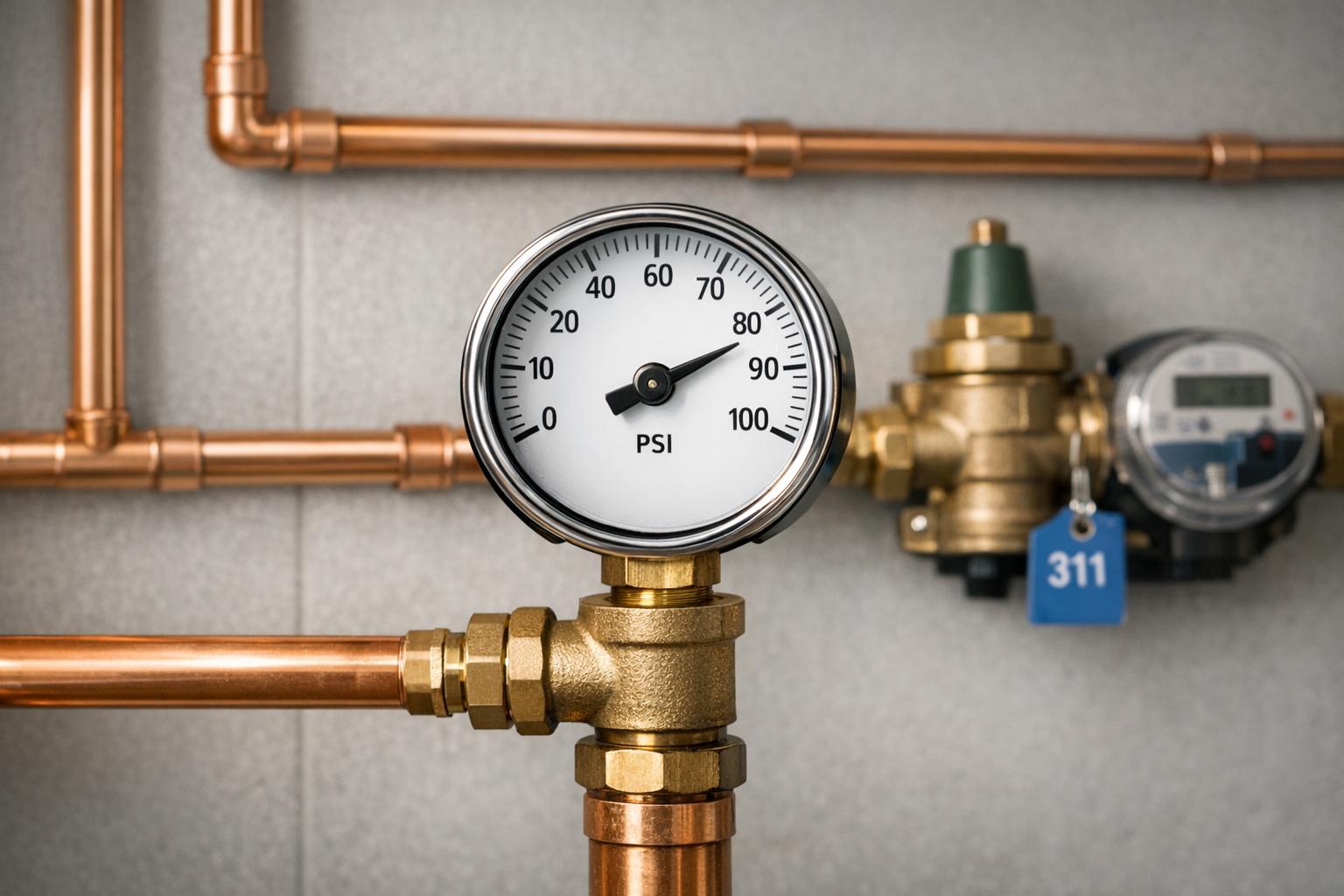

Maintaining proper water pressure in your Toronto home is key for smooth daily tasks and protecting your plumbing. Here's what you need to know:
- Ideal Pressure Range: Residential water pressure should be between 50–70 PSI for optimal performance. Anything below 40 PSI or above 80 PSI can cause problems.
- Common Issues: Low pressure is often caused by municipal supply issues (e.g., watermain breaks, peak-hour demand) or household problems like corroded pipes, faulty pressure-reducing valves (PRVs), or mineral buildup.
- DIY Testing: Use a pressure gauge (approx. $15) to measure static pressure at your home. Check for leaks using your water meter or inspect fixtures for mineral deposits.
- Solutions: Simple fixes include cleaning aerators and ensuring valves are fully open. More complex issues like replacing PRVs ($300–$450) or upgrading old pipes ($4,000–$12,000) may require professional help.
- When to Call for Help: Contact 311 for city-side issues like watermain breaks. For internal plumbing problems, hire a licensed plumber.
Toronto's aging infrastructure and fluctuating demand can impact water pressure, but regular maintenance and timely repairs can keep your system running smoothly.

Toronto Water Pressure Guide: PSI Ranges, Costs, and Action Steps
Toronto's Water Pressure Standards
Normal Water Pressure Ranges
Toronto Water delivers water to homes at a regulated pressure of 40–80 PSI at the curb, which serves as the starting point before it flows into your property. For residential properties, the city defines an acceptable flow rate as 7 L/min or more. If a flow test reveals your supply falls below this level, Toronto Water will prioritize replacing the water service pipe - typically within seven days.
While 40 PSI meets legal standards, it can feel insufficient in homes with multiple fixtures running simultaneously. Most plumbing fixtures in residential settings are built to handle up to 80 PSI, but exceeding that limit can cause problems like pipe damage, water hammer, or even burst hoses. For most Toronto homes, the ideal pressure range is 50–70 PSI, offering a balance of strong performance across fixtures without straining the system.
Pressure-reducing valves (PRVs), commonly installed in Toronto homes, are factory-set to maintain safe pressure levels between 45–60 PSI to safeguard internal plumbing from excessive municipal pressure. If your home consistently experiences pressure above 80 PSI, you may need to install or replace a PRV. This typically costs between $300 and $450.
These guidelines provide a foundation for understanding how Toronto's infrastructure impacts water pressure in everyday use.
How Toronto's Water Infrastructure Affects Pressure
Toronto’s water pressure is not just about the numbers - it’s also influenced by infrastructure and geography. During peak usage times, pressure can temporarily drop to around 40 PSI as multiple fixtures are used across the system. This drop is expected and designed to stay within municipal standards.
Elevation is another key factor. Water pressure decreases by approximately 0.43 PSI for every vertical foot of elevation. For instance, a home’s second floor may experience about 8 PSI less pressure compared to the ground floor. Older neighbourhoods often face additional challenges like aging water mains or corroded galvanized steel pipes, which can narrow over time and restrict water flow. On top of that, the City of Toronto is dealing with an increased number of watermain breaks, which can cause localized drops in pressure.
Common Causes of Low Water Pressure in Toronto
Municipal Supply Issues
In Toronto, watermain breaks are a frequent cause of sudden water pressure drops, especially during winter. The city's fluctuating temperatures can wreak havoc on aging infrastructure. For instance, a major break in January 2026 at Front Street E. and Scott Street led to immediate service disruptions and road closures. Krystal Carter, a spokesperson for the City of Toronto, explained, "water main breaks can be common this time of year due to sudden changes in temperature".
Peak-hour demand is another factor. During the busiest times - typically 6:00–9:00 AM and 6:00–9:00 PM - neighbourhood water usage often pushes pressure down to the legal minimum of 40 PSI.
Additionally, scheduled maintenance and construction can temporarily lower water pressure. The City usually provides advance notice for such work, and residents can check the "No Water Map" on Toronto's website for updates. However, during busier periods with numerous watermain breaks, non-urgent repairs may take up to 72 hours to address.
While these municipal issues are common, problems within your own plumbing system can also contribute to low water pressure.
Household Infrastructure Problems
In older Toronto homes, corroded piping is a frequent issue. Homes built before the 1960s often feature galvanized steel or lead pipes. Over time, these materials accumulate rust and mineral deposits, narrowing the pipes and restricting water flow. Since cleaning won't fix the problem, a complete replacement is usually necessary. Replacing galvanized pipes with PEX can cost anywhere from $4,000 to $12,000.
Undersized service lines are another concern. Many older homes were designed with plumbing for a single bathroom. As families expand and add more bathrooms, these outdated service lines may struggle to provide adequate water flow, even if municipal pressure at the curb is sufficient. It's worth noting that Toronto Water won't test private systems with lead or galvanized steel pipes due to the risk of pipe failure during testing.
Internal Plumbing Failures
Pressure-reducing valves (PRVs) are a common source of sudden, whole-home pressure loss. These valves, which are typically set at 45–60 PSI, can fail over time due to sediment buildup or spring wear. Replacing a faulty PRV usually costs between $300 and $450. Similarly, partially closed shut-off valves, including a seized main valve, can restrict water flow. Before calling a plumber, check that your main "stop and waste" valve is fully open.
Hidden leaks can also quietly drain water pressure. A simple test involves turning off all taps and recording the water meter reading for two hours. If the reading changes, you likely have a leak.
Finally, mineral buildup in fixtures like faucet aerators and showerheads is a common, easily fixed issue. Toronto's moderately hard water often leaves deposits that reduce flow. Soaking aerators in vinegar can dissolve the scale and restore proper function.
How to Diagnose Water Pressure Issues
Using a Pressure Gauge
To get started, pick up a hose-bib pressure gauge from your local hardware store - it’ll cost you about CA$15. Before testing, make sure all indoor and outdoor faucets, along with water-using appliances, are turned off. This allows you to measure static pressure (the pressure when no water is flowing). Attach the gauge to an exterior hose tap, preferably the one closest to your water meter, or use the cold water connection for your washing machine. Open the faucet fully and check the reading on the gauge. Ideally, static pressure should fall between 50–70 psi at the main level of your home. For upper floors, expect a slight drop of roughly 8 psi.
"Anything below 50 psi is considered weak for a two-bath home." – Anta Plumbing
To figure out if the issue is related to neighbourhood demand, repeat the test during peak water usage times, such as 6:00–9:00 AM or 6:00–9:00 PM. If pressure only dips during these hours, the problem is likely due to high demand in your area rather than an issue within your home.
| Pressure Level | Status | Recommended Action |
|---|---|---|
| Below 40 psi | Below Legal Minimum | Check for supply issues or leaks with Toronto Water or consult a plumber |
| 40–50 psi | Weak | Consider a booster pump, especially for homes with multiple bathrooms |
| 50–70 psi | Ideal | This is the standard range for residential plumbing in Toronto |
| Above 80 psi | Dangerously High | Replace or adjust the Pressure Reducing Valve (PRV) immediately |
Once you’ve confirmed your static pressure, it’s a good idea to check for hidden leaks using your water meter.
Checking for Leaks with the Water Meter
Your water meter, usually located in the basement, includes a flow indicator - this might be a small red triangle or black star that rotates when water is flowing. To check for leaks, shut off all taps and water-using appliances, then watch the indicator for about five minutes. If it moves, you likely have a leak.
For a more detailed check, note your meter reading, wait two hours without using any water, and then check the reading again. If the numbers have changed, a hidden leak is the culprit. Toronto residents can also use the MyWaterToronto online tool to monitor daily water usage. Sudden spikes in consumption could point to a problem.
Even a tiny 1/16" hole can waste an astonishing 3,570 litres of water in just 24 hours. Detecting leaks early can prevent unnecessary water loss and save you money. If these tests reveal an issue, it’s best to consult a professional for further inspection.
When to Call a Professional
When your tests show persistent pressure issues, it’s time to bring in an expert. For example, if your static pressure is fine but drops significantly at certain faucets, you may be dealing with internal scaling or friction losses that require professional attention. Similarly, if your pressure exceeds 80 psi, a licensed plumber will need to adjust or replace your PRV to avoid potential pipe damage.
Homes with lead or galvanized steel pipes need extra care. Toronto Water won’t perform pressure tests on these systems due to the risk of pipe failure. In such cases, professional services are essential. Creed Plumbing, for instance, offers specialized leak detection services, ranging from CA$350 to CA$900 for acoustic detection and spot repairs. They can also handle PRV replacements or even full system repiping if corrosion has become severe.
Pinpointing the root cause of water pressure problems is crucial for maintaining a well-functioning plumbing system in your Toronto home. Accurate testing and timely repairs can make all the difference.
How to Check Your Home Water Pressure. ✅ Test to see your house has a normal water PSI! 🕘
sbb-itb-466cac3
Solutions for Restoring Water Pressure
Once you've identified the cause of your water pressure issues using a gauge and leak tests, you can start applying the right solutions to bring back proper flow.
Simple Fixes for Common Issues
Start by checking the main shut-off valve near your water meter. Ensure it's fully open - its handle should align with the pipe. Sometimes, older gate valves can get stuck halfway, unknowingly restricting water flow.
Next, focus on cleaning aerator screens. Remove them and soak in white vinegar for several hours to dissolve mineral deposits. Toronto's water, with an average hardness of 124 mg/L, can cause calcium buildup over time. For showerheads, an overnight soak in vinegar can help clear limestone and dirt. If you're having hot water pressure problems, confirm that the water heater's shut-off valve is open and flush the tank to remove sediment. If your home uses a water softener, try bypassing it temporarily to see if it's causing the issue.
If these straightforward steps don't solve the problem, you may need to explore more detailed repairs.
Intermediate Repairs and Adjustments
If cleaning doesn't improve the pressure, the issue might lie with your Pressure Reducing Valve (PRV). Use a pressure gauge to test the PRV's outlet side. If the pressure is fine there but drops at distant fixtures, internal pipe scaling could be the culprit. In this case, replacing the PRV with an adjustable, lead-free bronze model can quickly restore pressure. Expect to spend around CA$300–CA$450 for this replacement. If you're adjusting the PRV yourself, turn the adjustment screw no more than a quarter-turn at a time and avoid exceeding 80 psi to prevent damage to your plumbing.
For homes located at higher elevations, gravity can reduce pressure by approximately 0.43 psi per vertical foot. Installing an inline booster pump with a pressure tank may be necessary, with installation costs typically ranging from CA$1,200–CA$2,000. Before investing in this solution, test your water pressure during off-peak hours to rule out neighbourhood demand as the issue. If pressure remains low even during these times, a booster pump might be the right fix. However, if pressure dips noticeably during peak usage times (e.g., 6:00 a.m. to 9:00 a.m. or 6:00 p.m. to 9:00 p.m.), the municipal supply may be under strain.
If these adjustments still don't resolve the issue, larger upgrades might be necessary.
Major Upgrades and Replacements
Older homes in Toronto often have galvanized steel or lead service lines, which can severely restrict water flow. For example, a 3/4" pipe with just 1/8" of rust or calcium buildup can function like a 1/2" pipe, reducing water volume to less than 25% of what a 1" pipe can carry. Replacing these lines with a modern 1" copper or PEX-A pipe provides a long-term solution. Additionally, upgrading the water meter to match the new pipe size is essential to prevent bottlenecks.
For internal plumbing, a full-home repipe can address issues caused by ageing galvanized or scaled copper pipes. This process typically costs between CA$4,000 and CA$12,000, with most single-storey bungalows requiring two to three days for completion. While this is a more significant investment, it permanently resolves problems caused by decades of mineral buildup and corrosion. It's worth noting that Toronto Water won't perform pressure tests on lead or galvanized pipes, so upgrading these materials is often a necessary first step before seeking municipal assistance.
| Problem Found | Recommended Remedy | Typical Cost |
|---|---|---|
| Failed PRV | Replace with an adjustable, lead-free bronze model | CA$300–CA$450 |
| Galvanized or scaled copper | Sectional PEX-A upgrade or full-home repipe | CA$4,000–CA$12,000 |
| Whole-house low pressure | Install an inline booster pump with pressure tank | CA$1,200–CA$2,000 |
| Localized fixture drop | Clean or replace the aerator/shower cartridge | CA$90–CA$180 |
When to Contact Toronto Water vs. a Licensed Plumber
Understanding who to call can save time and hassle when dealing with water issues. The key is knowing where responsibility lies - municipal issues stop at the property line, while anything inside your home is your responsibility.
Toronto Water's Role
If your entire home loses water or experiences a sharp drop in pressure, your first call should be to 311. Toronto Water typically responds within 4 hours for complete outages and within 24 hours for sudden pressure drops. They handle municipal issues like watermain breaks, construction-related disruptions, and problems with water meters.
Before reaching out, check the City's "No Water Map" online to see if planned maintenance or emergency repairs are already underway in your area. If multiple homes in your neighbourhood are affected, it's likely a municipal issue. Toronto Water conducts flow rate tests to confirm the problem; any reading below 7 L/min usually indicates the need for pipe replacement. Municipal repairs are free, but if the City needs to shut off your water at the property line for private-side repairs, a fee applies.
If the issue is limited to specific areas of your home, you’ll need to contact a licensed plumber, as Toronto Water does not handle internal plumbing.
Licensed Plumbers' Role
Localized water problems typically point to internal plumbing issues. If diagnostic tests reveal the problem is isolated to fixtures or pipes inside your home, it’s time to call a licensed plumber. These professionals handle a wide range of internal plumbing concerns, including:
- Diagnosing and fixing failing Pressure Reducing Valves (PRVs)
- Addressing mineral buildup in pipes
- Repairing internal leaks or frozen pipes
- Replacing seized shut-off valves
Plumbers use specialized tools like pressure gauges and acoustic leak detection to identify and resolve internal issues, services that Toronto Water does not provide.
Homes with lead or galvanized pipes require professional attention. Toronto Water will not test these materials and will recommend upgrading your pipes before investigating further. For tenants in apartments or condos, contact your landlord or building superintendent, as water pressure problems in multi-residential buildings are typically internal.
If you need internal repairs, licensed plumbers like Creed Plumbing offer a range of solutions, including resolving water pressure issues and upgrading outdated systems.
| Responsibility | Toronto Water | Licensed Plumber |
|---|---|---|
| Pipe Coverage | Municipal watermain up to the property line | From the property line into your home |
| Testing Services | Free flow test (if pipes are not lead/galvanized) | Internal diagnostics and leak tracing |
| Common Issues | Watermain breaks, hydrant work, construction | PRV failures, mineral buildup, internal leaks |
| Response Time | 4–24 hours for emergencies | Varies by contractor (24/7 for emergencies) |
| Cost | Free for municipal repairs; fee for shut-off | Homeowner-funded for internal repairs and upgrades |
Conclusion
Maintaining consistent water pressure is essential for protecting your home and avoiding costly damage. Keeping an eye on your system helps you catch problems early - like pressure surges above 80 psi that can burst pipes and cause flooding, or drops below 50 psi that disrupt daily activities and routines.
The best approach? Stay ahead with regular maintenance. Routine checks can uncover small issues before they turn into expensive emergencies. Simple tasks like cleaning aerators, checking your water meter for leaks, and ensuring your main shut-off valve is fully open can help keep your water pressure steady and your repair bills low.
When it comes to more serious issues - like failing pressure-reducing valves (PRVs), corroded pipes, or ongoing low pressure - it’s worth calling in the pros. Licensed plumbers have tools like acoustic leak detectors and advanced pressure testing equipment to pinpoint hidden problems, saving you time and preventing minor repairs from spiralling into major projects like repiping.
If your home was built before the 1980s and still uses galvanized steel pipes, be aware that these are likely nearing the end of their lifespan. If you’re noticing consistently weak water flow, it’s a good idea to have a professional inspect your system before the situation worsens.
FAQs
How can I figure out if low water pressure in my home is caused by city services or a plumbing issue?
If you’re dealing with low water pressure, the first step is figuring out whether the problem is confined to one area or affecting your entire home. If it’s just one fixture or a specific spot, the issue is likely internal. Common culprits include a clogged aerator, a partially closed shut-off valve, or even frozen pipes.
However, if the low pressure is noticeable across multiple fixtures in your home, the cause could be external. This might include municipal watermain breaks, city maintenance, or a surge in local water demand.
Start by checking your main water shut-off valve to ensure it’s fully open - a slightly closed valve can significantly reduce water flow. If everything inside your home appears to be in working order, it’s a good idea to reach out to the City of Toronto’s water department or check for updates on municipal water services. This can help you pinpoint whether the issue stems from your home or the city’s water supply.
How can I tell if my pressure-reducing valve (PRV) needs replacing?
If your home's water pressure remains consistently low despite trying simple fixes like cleaning aerators or clearing blockages, your pressure-reducing valve (PRV) might be the culprit. When a PRV fails, it can no longer regulate water pressure effectively, resulting in a weak flow to your taps, showers, and appliances.
Other warning signs of a failing PRV include irregular pressure changes, visible leaks around the valve, or noticeable corrosion and damage. Once you've ruled out other possibilities - like issues with your municipal water supply or clogged pipes - it’s a good idea to have the PRV inspected. Since this valve is essential for maintaining safe and steady water pressure, hiring a licensed plumber to replace it is the best way to keep your system running smoothly and prevent further complications.
How do I know when it’s time to replace old galvanized pipes in my Toronto home?
If you’re dealing with low water pressure, discoloured water, or frequent clogs, it might be time to replace your old galvanized pipes. These pipes, commonly found in Toronto homes built before the 1960s, tend to corrode and accumulate calcium deposits over the years. This not only restricts water flow but can also lead to leaks and negatively affect water quality.
Homes built before the mid-20th century are especially at risk. If your pipes show visible rust or damage, switching to modern materials like copper or PEX can make a big difference. Upgrading can boost water pressure, improve the quality of your water, and lower potential health risks. In fact, the City of Toronto recommends replacing galvanized or lead pipes in older homes to help prevent drinking water contamination. A licensed plumber can evaluate your plumbing system and guide you on the best replacement options.